
Close

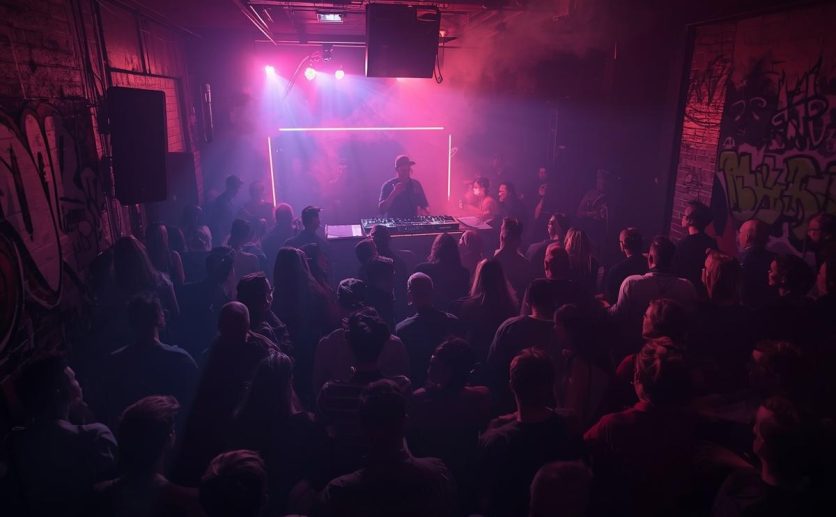
The birth and death of music scenes represent some of the most fascinating cultural phenomena in modern society. From the punk explosion of the 1970s to the EDM boom of the 2010s, every dominant musical movement began as a small, underground community. Therefore, understanding this lifecycle isn’t just academic—it is, in fact, crucial for musicians, promoters, and fans. Ultimately, this knowledge empowers them to either preserve a scene’s authenticity or successfully navigate its inevitable commercial evolution.
In this comprehensive guide, we’ll trace the complete trajectory of underground music scenes, examining each phase of development and the forces that propel scenes from obscurity to mainstream recognition and eventual transformation.
Every significant music movement starts with a small group of innovators operating outside the mainstream. This initial phase is characterized by several key elements:
The Catalyst Elements:
Historical Example: Detroit techno emerged in the 1980s from the Belleville Three—Juan Atkins, Derrick May, and Kevin Saunderson—who fused electronic sounds with funk and futurist ideals, creating a new musical language from their isolated position outside the traditional music industry.
As the initial spark gains traction, the scene begins developing distinct characteristics:
Identity Formation:
The Role of Technology: In today’s landscape, scenes can develop simultaneously across geographic boundaries through digital communities, accelerating this phase considerably compared to historical movements that relied on physical proximity.
This crucial transition phase occurs when the scene captures broader attention:
Indicators of Approaching Tipping Point:
The Authenticity Crisis: This stage often triggers debates about “selling out” as early adopters worry about dilution of the original values and sound that defined the scene’s early days.
The scene becomes a recognized market category with significant commercial infrastructure:
Commercial Development:
Case Study: The EDM Boom
What began as underground warehouse parties in Detroit and Chicago evolved into a global phenomenon, with Las Vegas residencies, corporate sponsorships, and billion-dollar festival brands. This transformation created unprecedented commercial opportunities while fundamentally changing the culture’s relationship with its origins.
Every scene eventually reaches maturity, leading to several possible outcomes:
Potential Evolutionary Paths:
Today’s music scenes develop at an accelerated pace thanks to digital connectivity, but this presents both challenges and opportunities for maintaining authenticity:
Strategies for Sustainable Scene Development:
In my experience, being deeply involved in underground music event planning, I’ve witnessed firsthand how promoters can either extend or shorten a scene’s natural lifecycle.
Best Practices for Ethical Promotion:
To sum up, the journey of music from underground to mainstream is not a failure, but rather a natural process. It is true that commercial success changes things, but it’s important to see the bigger picture. For instance, new and exciting styles are always forming on the edges of culture, which allows them to speak directly to new generations.
Because of this, a healthy music scene doesn’t try to stop this cycle. Instead, it focuses on supporting many different spaces where all types of music can exist at once. From small basement shows to huge stadium tours, each one meets different needs and, at the same time, adds to a rich and varied cultural world.
In the end, the strongest music scenes are those that accept change while also respecting their history. As a result, they create living traditions that can grow without losing their soul. Therefore, our job as fans and supporters is to help these entire ecosystems thrive, rather than trying to keep them stuck in one moment in time